Sofia Borges: percussion, drums, composition
Camila Nebbia: tenor sax, composition
“Sofia and Camila jumped into a free fall over the festival audience with impressive confidence.” Sofia Rajado, jazz.pt
“The duo (Boges/Nebbia) dialogued efficiently and creatively, and finally ended with one last moment, full of the intensity that characterized the entire performance. There was vigorous applause, and many of those present stood up to do so.” João Morado, Rimas & Batidas
The duo of Camila Nebbia and Sofia Borges is far from being just another project in both their careers. They have many characteristics in common and it isn’t only the fact of being two foreigners living in Berlin: Nebbia is from Argentina and Borges was born in Portugal. This happens frequently in the most cosmopolitan of all the cities of Germany, so no news here. Most important is the fact that, besides music, they have a parallel activity in visual and performance arts. Nebbia with Super 8, destroyed archives, expanded cinema and digital vídeo, and Borges evolving herself with dance and theatre shows. Sometimes they contribute to interdisciplinary collective works and in other occasions they do it all in solo formats.
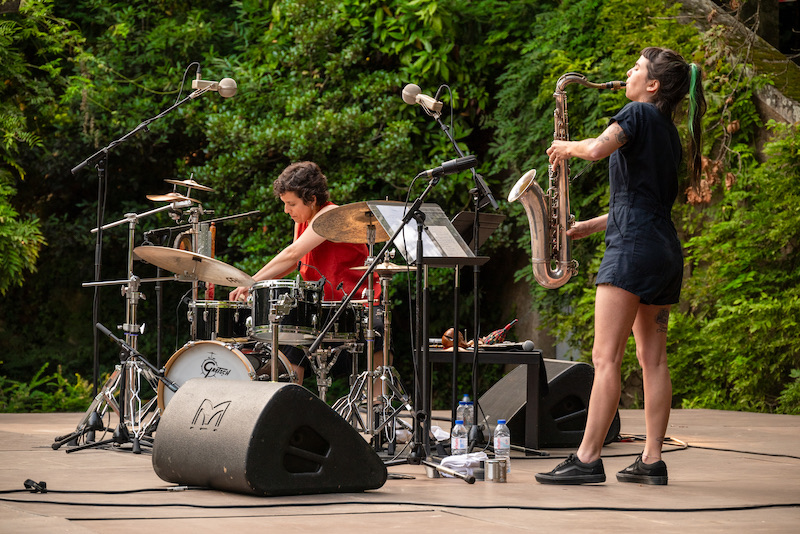

True is that music is their main creative medium, Nebbia playing tenor saxophone and Borges unfolding several instruments and materials: drums, percussion, field recordings and electronics. Also, both explore new ways of mixing improvisation and written composition, in the last case be it with conventional notation or with graphic scores. But even if this is their main expressive tools, the influence of their visual and performative side dedications is reflected in the art of sounds. Camila Nebbia is very kinematic and imagistic in her playing and Sofia Borges turns more performative the already existing nature of a live concert as a performance act. This is how that happens either solo or in associations with top names like Michael Formaneck, Tom Rainey, Susana Santos Silva (Nebbia), Craig Taborn, Mat Maneri, Axel Dorner, Robyn Schulkowsky (Borges), among many others. Separately they have admirable paths, together they are unbeatable.
What must we expect? A music that experiments and investigates the relations between time and space, dealing with memory and identity, and expanding the established languages to find other possibilities, other configurations. The objective: to invent unexpected sonic fields, either structured or spontaneous, or structured and spontaneous in the same piece, with its boundaries becoming undifferentiated. When is it improvised, when is it composed? Only Camila Nebbia and Sofia Borges know and no-one else among us, the listeners.
 Sofia Borges